Decide · Build · Verify · Last — with AI
Everyone now has the same AI tools. That raises the floor — not the ceiling. The gap between the two is you.
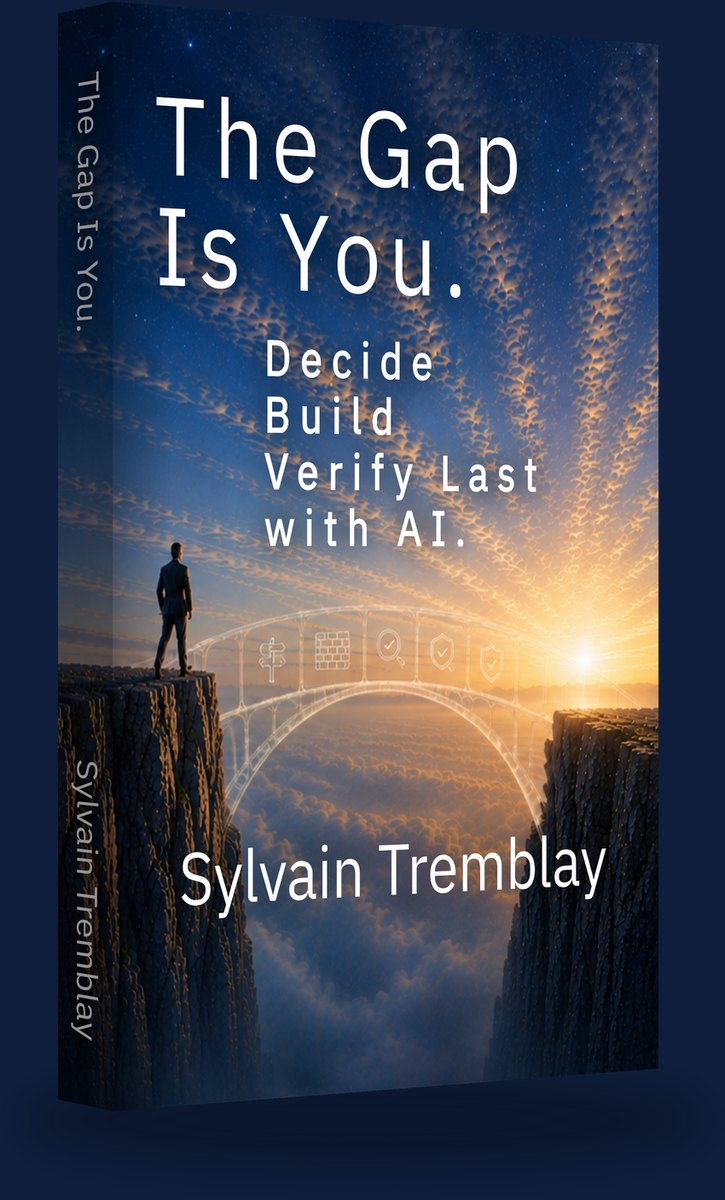
This book isn't about technology. It's about decisions: which task to automate, how to build a workflow that holds, how to design checking before a well-worded error slips past unnoticed. No product named, no screenshots — only grids, thresholds, and numbers nobody else publishes.
For small business owners, managers, and consultants ready to move from the why to the how.
Which task to hand to the machine, and where to stop. A grid, not a hunch.
How to chain the steps so the result still holds next week, not just today.
Designed before the error, because a wrong answer that reads well does not announce itself.
The Gap Is You. is Sylvain Tremblay's second book on artificial intelligence, designed for small and medium-sized businesses. Unlike his first work, AI in Action, which is organized by functional departments (marketing, customer service, content), this book adopts a fundamentally different architecture: rather than compartmentalizing AI by business unit, the author structures the entire narrative around stages of logical reasoning that build upon one another.
The work comprises 16 chapters, supplemented by a dedication, a substantial foreword, and appendices.
The book is specifically designed for decision-makers: business owners, managers, consultants, and independent professionals. It is crafted for those who make strategic choices regarding AI—particularly deciding what to delegate to machines, documenting what must be documented before deploying tools, recognizing problematic outputs, and knowing when to abandon a project that has become unprofitable.
The author explicitly acknowledges that this book is not a technical how-to manual. That dimension—writing complex instructions, configuring workflows, and integrating specific tools—belongs to a companion volume titled Hands-On AI (forthcoming). The Gap Is You. focuses entirely on strategy and judgment.
Four real-world situations function as archetypes, recurring throughout the book. This anchoring technique ensures every abstract principle is illustrated and tested against diverse, concrete cases.
Production of word-search books, where a single error triggers costly reprinting.
Property appraisal for real estate acquisition, where error has major, irreversible financial consequences.
Preparation of a business valuation dossier for prospective buyers, where error undermines credibility.
Writing meeting minutes, where error carries minimal real consequence.
Together, these four cases cover nearly all the risk and complexity profiles a small business encounters, allowing readers to identify with one and adapt the guidance to their own situation.
Each chapter can be read at three levels of depth, so readers of different profiles can extract what serves them best.
Expressed in a single memorable sentence; it can stand alone.
The principle demonstrated on one of the four archetypes, with specific numbers and details.
Technical deepening for those already building something.
This three-part system offers rare flexibility: one can read only the principles and emerge with the book's full structure, or dive deeply to be ready to start implementing Monday morning.
The work adheres to two strict editorial constraints that distinguish it sharply from technical AI literature.
This choice is not editorial caution but a deliberate strategic decision. Rather than naming tools that will be obsolete in three months, the author discusses classes of capabilities: what language models do well, what configured assistants enable, what persistent workspaces change in operations. These abstract categories preceded today's brands and will outlast them.
This is fundamentally a book about what a company must be able to do—whether AI exists or not—and what AI makes simply urgent. Detailed technique, specific tool integration, scripts and configurations: those belong to the companion Hands-On AI.
The central ambition is to equip readers with a personal, transferable framework for judgment—a method for evaluating any newly encountered case, not merely the examples in the book.

Sylvain Tremblay has been an IT consultant and entrepreneur for more than thirty years. He has founded and run several businesses, which gave him firsthand knowledge of what small businesses actually work under: tight budgets, small teams, decisions made without a safety net.
Since the arrival of generative AI, he's spent a good part of his time testing it in his own businesses rather than reading about its promises. His books come from that practice, not from theory.
He is the author of AI in Action. The Gap Is You. is the second book in the series.

Décider · Construire · Vérifier · Durer — avec l'IA
The same book in French, published under Éditions ST. Out since August 30, 2026, in paperback, hardcover and ePub.
Paperback and hardcover are printed on demand and shipped from the printer nearest you. The ePub is carried by Amazon.
Sign up and get the free guide — Decide, build, verify and last with AI, together with the five-criteria decision grid and the seven most common mistakes checklist.
After that, new releases from the house, and nothing else. An irregular newsletter, sent when there is something to announce.